Chapter 3. Cited is not recommended
By the end of this chapter you will know why an engine quoting your pages and an engine recommending your product are separate measurable events, how loosely the two move together, and why a supplier who reports them as one number is hiding the more useful of the two signals.
The claim this chapter defends
Measured, Volume II. Brand naming and domain citation correlate, but loosely: Pearson r = 0.512 and Spearman ρ = 0.577, at p < 10⁻⁶. Measured, Volume II. 29.4% of companies were cited more often than they were named, and nine companies were named zero times while their own domain was cited as a source, one of them five times out of ten. Reasoned. Being quotable and being recommendable are different properties of the same company, and a content strategy aimed only at the first will not deliver the second.
Operator disclosure. Broadcastwell ran this measurement and sells services in the category it measures. Broadcastwell is excluded from the measured sample and from every ranking. The mitigation is not that the conflict is absent, it is that the raw data and the code are public and the result can be recomputed by anyone who disagrees.
Two events, scored separately, on purpose
Measured, Volume II. For every answer the study recorded two independent binary outcomes: whether the company's brand was named in the answer, and whether its own domain appeared among the sources the engine cited. Reasoned. Those are different events in the machine. Citation is a statement about where the engine went for evidence. Naming is a statement about which vendors the engine put in front of the buyer. Scoring them together into one visibility percentage destroys the distinction, and the distinction turns out to carry most of the diagnostic value in this chapter.
The correlation is real and it is weak
Measured, Volume II. Pearson r = 0.512 between times named and times cited, with Spearman ρ = 0.577, both significant at p < 10⁻⁶. Reasoned. A correlation of that size means the two signals share roughly a quarter of their variance and differ in the rest. It is strong enough that nobody should claim they are unrelated, and weak enough that nobody should treat one as a proxy for the other. If citation predicted naming reliably, the sensible strategy would be to maximise quotable content and wait. The measured relationship does not support that.
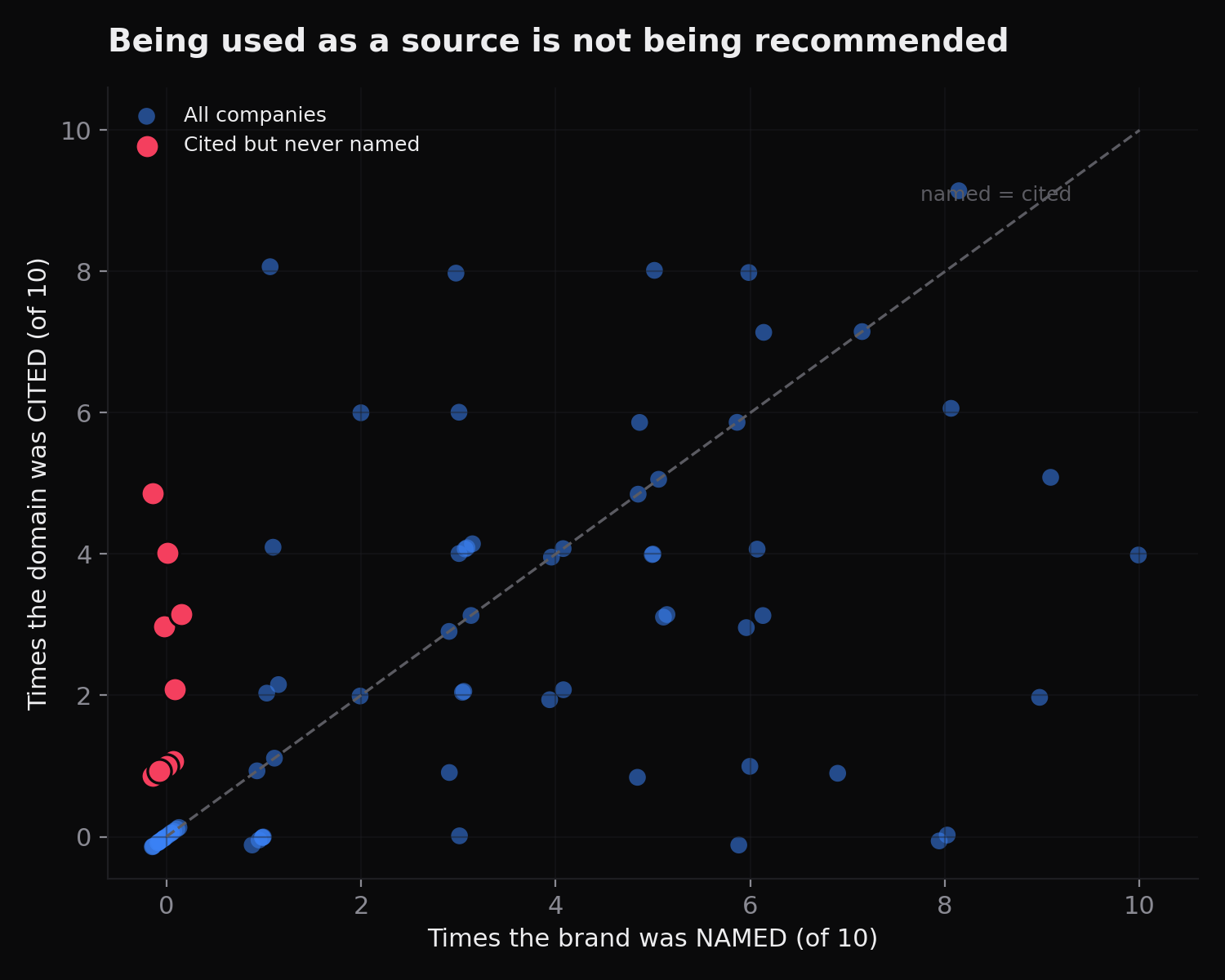
Nearly a third are cited more than they are named
Measured, Volume II. 29.4% of companies were cited more often than they were named. Among that group, the average company was named 2.2 times and cited 4.4 times. Reasoned. Twice as many citations as namings is not a rounding artefact. For those companies the engine is reading their material, treating it as usable evidence, and then writing an answer that recommends somebody else. Whatever is failing for them, it is not the production or the discoverability of content, because both are demonstrably working.
The nine that are cited and never named
Measured, Volume II. Nine companies were named zero times while their own domain was cited as a source, and one of those was cited in five of its ten answers. Reasoned. This is the cleanest available demonstration that the two signals are separate. A company cited half the time and named none of the time is supplying the evidence layer for answers that recommend its competitors. The pages are working. They are working for somebody else. No single visibility percentage can represent that state, because the percentage has to choose which of the two events it counts.
Why this happens, stated as inference
Reasoned. An engine assembling an answer has two distinct needs: candidates to recommend and evidence to support the recommendation. Material that explains a category well, defines terms, or lays out how to evaluate options serves the second need without positioning its author as a candidate for the first. That is a plausible mechanism for the measured pattern and it is not tested here. Volume II observes the outcome and does not observe the retrieval, so treat the mechanism as a hypothesis that fits rather than a finding.
The commercial consequence for the cited-not-named group
Measured, Volume II. For companies in this group the binding constraint is not content volume. Reasoned. Adding more of the material that is already being cited will raise citation further and has no measured tendency to raise naming. The work that plausibly moves naming is different in kind: being present in the third-party places where an engine assembles a candidate set, and being described as a vendor of a thing rather than as a commentator on it. Chapter 9 at /category-door/ sets out the standards for that.
What the reverse case means
Reasoned. The mirror position, named more often than cited, is the more comfortable one and it carries its own risk. A company recommended without its own domain being used as evidence is being selected on the strength of what other sources say about it. That is durable while those sources persist and fragile if they change, and it is invisible to any measurement that reports naming alone. Volume II publishes both columns per company precisely so that either asymmetry can be seen.
Read the role a name plays in the answer
Reasoned. A name can appear because an engine recommends a vendor, identifies the publisher of a source, or describes a comparison between other companies. Those roles are not interchangeable. The presence of the same text string does not resolve what the answer told the buyer to consider. Keep the complete sentence and its surrounding context beside the extracted name so a reader can inspect the role directly.
How to inspect a naming and citation pair
Reasoned. First read the buyer's question. Then identify the vendors the answer actually proposes and the claims attached to each. Separately record the pages it cites and the publishers of those pages. If a publisher is named only as attribution for a source, label that role explicitly instead of treating it as a recommendation. If the wording is ambiguous, retain the ambiguity and the receipt. Do not turn a source mention into a stronger buying signal than the answer supports.
Reasoned. This distinction matters when evaluating a proposed fix. A page already used as evidence may need clearer product relevance, while a vendor named through other sources may need to inspect those sources first. The observation should identify the question, the role of each name and the cited page before a change is proposed. Repeating the question can test whether that pattern persists; it does not make a single ambiguous answer conclusive.
What a measurement has to publish to be readable here
Reasoned. Three things. The naming count and the citation count as separate columns rather than a blended score. The identity of the source that was cited, so a citation of your own domain can be told apart from a citation of a page about you. And the answer text or enough of it to see whether a naming was a recommendation, a passing mention, or an attribution of evidence. Volume II publishes the first, Volume III publishes cited URLs per answer, and the third is the one most commercial tools do not offer.
Reading the four positions
Reasoned. Plotting naming against citation gives four positions and each implies different work. Named and cited: the engine both selects you and uses your material, which is the position to defend rather than to improve. Named but rarely cited: your selection rests on sources you do not own, which is durable while they last and outside your control. Cited but rarely named: the position this chapter is about, where supply of material is not the constraint. Neither: the category door, which is Chapter 1 at /named-zero-times/ and Chapter 9 at /category-door/.
Why the diagonal is the wrong expectation
Measured, Volume II. The published scatter of naming against citation places a line where the two counts are equal, and the companies scatter on both sides of it rather than along it. Reasoned. A tool that reports one blended visibility number is implicitly asserting that companies sit near that diagonal, because only then does one number stand in for both. The measured spread says otherwise. The further a company sits from the diagonal, the more information a blended score is discarding about it, and the companies furthest from the diagonal are exactly the ones with the most actionable diagnosis available.
The design decision that made this visible
Measured, Volume II. The two outcomes were scored separately and both columns are published per company. Reasoned. Nothing about the finding required a more sophisticated instrument than two checkboxes per answer. It required only that the two checkboxes were never added together. That is worth stating because it sets a low bar that most commercial reporting still does not clear: the separation costs nothing to collect and is lost only at the point where somebody decides a single headline number is easier to sell.
The limitation that bounds all of this
Measured, Volume II. All answers came from a single engine with one run per question, on a challenger-skewed sample of 85 companies in 60 categories. Reasoned. The 29.4% share and the count of nine are properties of that sample and that engine. The structural claim, that naming and citation are separable and can move in opposite directions, is the part that generalises, because it follows from the two events being different events. The proportions do not travel and should not be quoted as though they do.
What run-to-run variance does to the nine
Measured, Volume II. Volume II states that AI answers vary between runs and that it did not measure that variance. Reasoned. So the nine companies named zero times are nine companies that were named zero times on one run each of ten questions. A second run might have named one of them once. The finding that survives that uncertainty is the group-level one: a substantial minority of companies sit above the diagonal, cited more than named. The exact membership of the extreme group is less stable than the existence of the group. Chapter 6 at /measurement-noise/ puts numbers on how unstable.
The one number that would help instead
Reasoned. If a single figure has to be reported, the useful one is not naming or citation but the difference between them, signed. A positive gap says the engine selects you more than it quotes you, and your position depends on third parties. A negative gap says the engine quotes you more than it selects you, and your material is working as evidence rather than as candidacy. A gap near zero says the two signals are moving together and neither is the obvious constraint. Volume II publishes both columns per company, so the gap is available to anyone who wants it.
What this predicts about content strategy, and how to falsify it
Reasoned. The prediction is specific and testable: for a company already cited more often than it is named, adding more of the same kind of material should raise citation and leave naming roughly where it was. Anyone can falsify that by publishing a before-and-after on a named question set with both columns reported. No such test exists in these volumes, which is why this is offered as an inference rather than a result. If it turns out to be wrong, the honest correction is a published counterexample rather than a quiet edit.
What this chapter does not claim
Reasoned. It does not claim that citation is worthless, that being quoted has no commercial value, or that the two signals are independent, which the measured correlation rules out. It does not claim that any specific content change would convert citation into naming, because no intervention was tested. And it does not claim that engines deliberately separate sources from recommendations. The claim is that the two outcomes are separately measurable, measurably different, and routinely reported as one thing.
How to check your own position in ten minutes
Reasoned. Take the ten questions a buyer in your category would ask. For each answer record two things rather than one: were you named, and does your own domain appear among the cited sources. Then plot the pair. If citation exceeds naming you are in the group this chapter describes and your constraint is not content supply. If naming exceeds citation your position rests on third-party sources you do not control. If both are zero, Chapter 1 at /named-zero-times/ is the relevant starting point.
What this means for your buying decision
Reasoned. Ask any supplier to show naming and citation as two separate columns before you accept a single visibility number, and ask which of the two their proposed work is meant to move. A supplier who cannot separate them cannot tell you whether your content is failing to be found or failing to position you as a vendor, and those need different work. If the answer to "what will improve" is more content, ask what the citation column already shows. Chapter 12 at /how-to-buy-geo/ has the full question list.
Where to go next
Reasoned. Chapter 4 at /who-gets-cited/ looks at the citation side across the whole corpus and asks which kinds of domain the engine reaches for. Chapter 2 at /absence-ladder/ classifies the questions you are absent from, which is the other half of a diagnosis. Chapter 10 at /comparison-gate/ covers what a model needs in order to lift a claim about you into a comparison answer.
Sources
Every figure in this chapter comes from The 2026 State of GEO, Volume II: the Pearson and Spearman correlations, the 29.4% share, the 2.2 against 4.4 averages within that group, and the nine companies cited but never named. The per-company naming and citation counts are published in challenger_visibility_v2.csv at github.com/Broadcastwell/state-of-geo-2026. The dated collection records and their run structures remain in the published source repository linked above.
About this manual
Author. Sairam Sivakumar, Broadcastwell.
Operator disclosure. Broadcastwell ran this measurement and sells services in the category it measures. Broadcastwell is excluded from the measured sample and from every ranking. The mitigation is not that the conflict is absent, it is that the raw data and the code are public and the result can be recomputed by anyone who disagrees.
Historical research record. The dated collection designs and source files remain available in the published research repository and the three volumes linked below. The July 2026 collection used four engines and five runs per question; the 18 August 2026 collection used the same ten questions and four engines, with one run per question.
Reading dated measurements. Reasoned. Compare like with like. A change in the number of runs changes the evidence base, even when the questions and engines are unchanged. Keep the collection date, question wording, engine, run count and exclusions beside any result. Inspect the retained answers and sources before interpreting a difference as movement. Naming and citation answer different questions, so report them separately. A dated observation supports a claim about that collection; it does not establish a current result or prove that an intervention caused a change.
Not peer reviewed. This is an independent industry study published as an open dataset with the analysis code that produced every figure in it. It has not been through academic peer review. Read it as measurement, and check the measurement. If you disagree with a number here, recompute it from the public data and publish what you get.
Licence. Prose and figures CC BY 4.0. Site code MIT.
The three volumes.
| Volume | What it covers | DOI |
|---|---|---|
| Volume I | 85 companies, 61 categories, 860 scored answers and 5,160 citations, one engine held constant. The dataset README additionally records 1,753 unique domains cited | 10.5281/zenodo.21537014 |
| Volume II | The Absence Ladder. All 616 absence records classified by question shape | 10.5281/zenodo.21586091 |
| Volume III | Cross-engine divergence. 280 questions, 40 categories, four engines, 853 answers | 10.5281/zenodo.21789120 |
Data and analysis code for all three volumes: github.com/Broadcastwell/state-of-geo-2026.
Version 1.0, August 2026.